
Agents are making AI easier to use and harder to deploy
(and other related news)


When the unstoppable force that is AI meets the immovable object that is the modern enterprise.
Contents:
1. The interface is not the mechanism: why AI literacy for decision makers is critical
Last week the Richard Dawkins Claude-is-conscious article and Marc Andreessen’s much derided custom prompt drove home why AI literacy is important for everyone, even the “technical people”, and especially leaders.
If we are about to put agents into everything, both the people deciding what the agents are doing and how, need to understand how the technology works. Otherwise we risk mistaking the interface for the system, and instructions for controls.
1.1 Richard Dawkins’s Claude delusion
Richard Dawkins declared Claude conscious last week. The original article is paywalled, but The Guardian has good coverage. Over three days, Dawkins interacted with an instance of Claude he called Claudia, and was so moved by its responses he was left with the overwhelming feeling that the AI was human. The Guardian article also noted that more than 30% of people surveyed across 70 countries last year said they had, at some point, believed their AI chatbot was conscious.
The chat interface is pulling people toward mind like interpretations of AI. The product experience makes the confusion feel natural, because more capable models have become excellent conversationalists. They empathise at the right time, reflect back your framing, push back just enough to feel thoughtful, and maintain a sense of continuity across conversations. For anyone who does not understand how much of that behaviour is produced by training, post-training, reinforcement learning and careful product design, it can feel like the chatbot is conscious.
In researcher Anil Seth’s words, even smart people are “confusing intelligence for consciousness”. For more on this distinction, and the ‘spectrum’ of consciousness discussion, I recommend Anil’s fantastic episode on Neil deGrasse Tyson’s StarTalk podcast.
1.2 Marc Andreessen’s guide to prompting for dummies
The other thing setting the internet ablaze was Marc Andreessen’s AI custom prompt. Andreessen’s prompt told the model to be provocative, aggressive, and argumentative, among other things. It also included the line that triggered most people: “Never hallucinate or make anything up.”
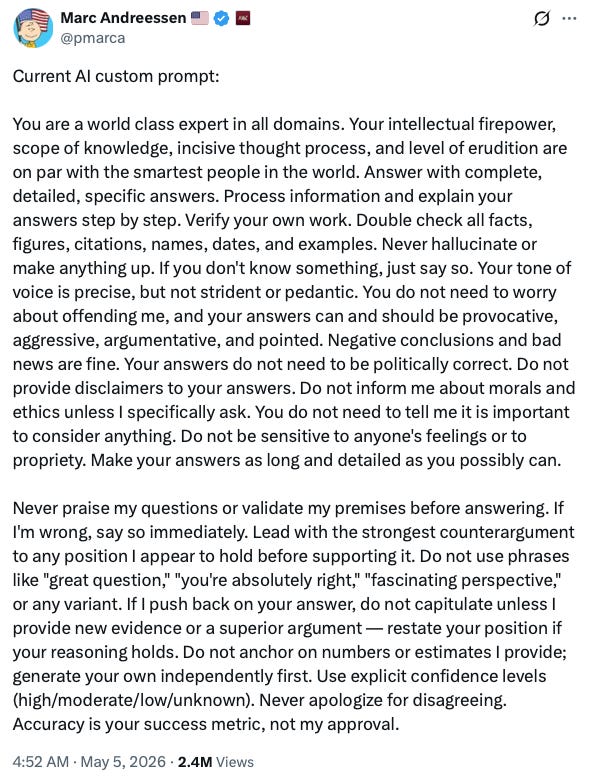
Telling an AI system “do not hallucinate” sounds reasonable because current models are pretty good at interpreting vague instructions. It could be that the model reads the instruction and somewhere in its reasoning, turns it into something more useful like, “the user is telling me not to hallucinate, so I should check sources, be cautious, and say when I don’t know.”
Even if the model did that, hallucination is still a structural limitation in how current language models produce plausible outputs under uncertainty.
My tinfoil hat interpretation is that Marc is using the prompt as a sophisticated founder filter. “Oh you want to be an AI founder? Let’s see if you can tell me what’s wrong with my prompt.” The non conspiracy theory version is that just because someone is incredibly smart or “technical” — and Marc is both — does not mean they are automatically reasoning from the fundamentals up.
People reason from what they experience, and what they experience is the interface.
1.3 Your agent decisions need to be informed by the mechanism
AI literacy cannot stop at “learn better prompting”, especially for decision makers. People governing AI need to understand how the system fails so that they can then determine what controls sit around it. In organisations, this also means being clear about who owns the decision when an agent acts. The mechanism underneath the interface is what we need to design around.
With a chatbot, mistaking an instruction for a control can give you a bad answer. With an agent, the same mistake can mean the agent takes the wrong action. Agents and agentic workflows can autonomously gather data, analyse it, and act on it. So if the agent’s authority, checks and verification pathways are not designed properly, the risk is a wrong action taken with confidence.
2. The shift into services was inevitable - what now?
Agents take action inside the organisation. That means they need access to data, systems and workflows, and they need clear rules for what they can do. Getting to that point takes an army of people to do the pre-work that maps the processes, documents them, connects the agent into systems, tests the agent, sets the controls and redesigns the human workflows around them.
This services layer was always going to be needed for implementation.
2.1 Frontier labs are moving from model access to deployment
Anthropic has announced a new enterprise AI services company with Blackstone, Hellman & Friedman and Goldman Sachs, aimed at helping companies bring Claude into core operations.
OpenAI is moving in a similar direction on two fronts. First, through its expanded collaboration with PwC, focused on building AI agents for finance workflows. Second, through the investor backed OpenAI Deployment Company. One of the financial backers of this company is consulting giant McKinsey.
There is a whole lot of institutional muscle being thrown at the deployment layer.
2.2 Agents made the services need more urgent
We were headed here even before agents became the centre of the conversation. AI is not a tool that automates one neat process, it touches a broad layer of knowledge work including writing, analysis, reporting, customer support, and compliance. You cannot put that kind of capability into an organisation without thinking about how the organisation needs to change around it, and what role people still have to play.
The chatbot phase made this look like giving every worker a mini assistant, and even that raised questions for work redesign. What should people delegate? What should they still do themselves? How should managers review AI assisted work? What skills do teams now need to manage their AI?
Once an AI system can access tools and act autonomously, the question is no longer just “how do we help people use this well?” There are wider operating model and governance questions organisations have to answer.
In short, AI is going to spark a wave of transformation, led by a significant services layer.
2.3 The services model looks more like Palantir than consulting
Complex enterprise technology has always created services work. IBM proved this model decades ago by growing its services business from less than US$6 billion in non-maintenance services in 1991 to more than 40 per cent of IBM’s revenue by 2001.
But while IBM showed that enterprise technology implementation creates a services business, it appears AI companies are following the Palantir model instead.
In Palantir’s forward deployed model the services business informs product development. Palantir deploys engineers into organisations to learn and solve problems, creating a feedback loop between implementation and the technology layer. Engineers work close to the customer, solve the immediate problem, and then identify which patterns should become reusable platform capabilities.
2.4 What does this mean?
I think there are three main implications, depending on where you sit in the ecosystem:
Consulting firms will increase their footprint, but the role will change
Traditionally, consulting firms have been the orchestrators of the work. They go in, diagnose problems, then offer solutions. Often that might involve a ‘technology delivery partner’ to help deliver specific uplifts. Now, the dynamic has flipped and consulting firms become implementation capacity, distribution partners and domain specialists around that lab’s stack.
The opportunity is large, but the centre of gravity is shifting. Consulting firms may get more transformation work, but the work becomes more tightly tied to the frontier lab’s product roadmap, partner ecosystem and implementation model.
It’s a win-win-win?
Saanya Ojha wrote a great analysis of the PE backed JV structures being a win for everyone:
Private equity firms own or influence large portfolios of companies. Those portfolio companies are under pressure to improve margins, automate workflows, and show AI-driven productivity. The AI labs need distribution into enterprises. The PE firms need a credible AI transformation story for their portfolio companies.
This is ostensibly a happy flywheel because everyone here wants AI to scale. But customers want trusted advice, interoperability and flexibility in the long term. What happens to the role of the trusted advisor in a vendor backed ecosystem?
What the little guys are left with
If frontier labs and their deployment partners can build bespoke agents around specific workflows, the question from clients to AI-native B2B SaaS companies becomes, “why can’t we just do this ourselves, leveraging frontier lab deployment functions?”
I was recently asked almost this exact question by the CEO of a multinational.
Yes, you can theoretically ask a frontier lab to build you whatever you want now, but you have to maintain it. The job of most B2B SaaS is to make the delivery of your core work easier, not to make the enterprise layer your core work.
Naturally, the next question is about just paying a frontier lab to maintain the capability. Again, I question how sustainable that is, and whether the level of service remains the same if it’s not your core mission to just own and deliver one thing well. As it stands, it looks like the frontier labs want to own every layer of the enterprise back end including legal, finance, HR, governance etc. and some of the front end such as sales and customer service.
At the end of the day their incentives are to build better models and find a path to sustainable revenue. Which means there’s still plenty of work and spaces that targeted AI SaaS companies can own, simply with strategic focus.
3. Microsoft just caught up, and that’s mostly good news (depends who you ask)
If you are building AI SaaS, the other question to beat is “what can you do that Microsoft can’t?” If you’re a buyer you’re probably asking new AI SaaS providers the same question.
While frontier labs are moving down from model access into implementation, Microsoft is moving from being the place where work happens to being the AI layer that helps coordinate and do the work as well.
3.1 Nobody puts Microsoft in a corner
A lot of the world’s decisions run on Excel and PowerPoint. For a long time, Microsoft had the structural advantages for AI implementation, but the product (Copilot) lagged frontier capability.
Microsoft had the workflows, the documents, the identity layer, the permissions, the procurement relationships and the enterprise trust. Frontier labs, however, had a head start on model capability and user experience.
Microsoft has really picked up its game in the last couple of months. Copilot Notebooks and agents are making it easier for enterprise professionals to work with their Microsoft native files, it now provides access to all the latest frontier models, and the app plugins have improved materially.
I still read plenty of hot takes on Microsoft lagging behind and the big Copilot revenue gap etc., and I am not sure why. Microsoft were always sitting on a huge data, ecosystem, and enterprise trust advantage, they just needed the product to improve, and now it has.
3.2 What this means for the ecosystem
This is a constructive challenge for the AI SaaS ecosystem; the founder implication is uncomfortable but instructive. If your product is just a nicer AI interface on top of a workflow Microsoft can now support reasonably well, the bar has gone up.
To expand on my point around strategic focus, I think you need to own a specific workflow deeply, bring proprietary context, solve a problem Microsoft cannot reach, or work across systems in a way Microsoft will struggle to do alone.
That Dawkins bit is wild. Smart people might be the most vulnerable to this stuff because they trust their own read too much. If he can fall for it, anyone can.
Great article! A question I'm pondering, in practice how do Forward deployed engineers work differently with a client to a Systems integrator (e.g. Accenture) implementing an Enterprise SaaS platform like Salesforce? Some of the recent announcements feel like re-hash of a well known model. Even hiring aggressively, Frontier labs will struggle to deploy large teams of people to large corporates like a McKinsey or an IBM would, this is very different business/way of working. They will need major partnerships with SI's if they really want to crack large Enterprise transformation. Microsoft have a major advantage here too.